
Behind every impactful startup is a story not just of innovation, but of lived experience, resilience, and clarity earned through hard lessons.
For Siok Hwee, entrepreneurship wasn’t sparked by trend-chasing. It was born from a deeply personal life experience, and strong determination to solve a pressing, yet underserved problem in the clinical trials process.
As a senior clinical scientist with over 16 years of experience in personalised medicine and clinical research, Siok Hwee understood clinical trials better than most.
However, building a startup is a whole different ball game. How could one turn a mission driven idea into a scalable, investable venture?
Siok Hwee is one of many first-time startup founders who kickstarted their entrepreneurial journeys with Asia Startup Network’s Prefounder Catalyst Programme. Having completed the programme, she has since started a firm that helps clinical trials find suitable candidates more effectively.
In this Q&A, we sat down with Siok Hwee to learn about her journey from clinical research to entrepreneurship, and how the ASN Prefounder Catalyst Programme helped her transform a mission into a startup.
Q: Can you tell us a bit about your professional background?
I bring 16 years of experience in personalized medicine and clinical research, having worked in FDA-regulated environments at companies such as Illumina, Abbott, and MSD. My work focused on running global clinical trials and securing regulatory approvals across both medical devices and pharmaceuticals.
That experience gave me a deep understanding of how clinical trials operate — but it also revealed where the system breaks down.
Q: What drove you to pursue entrepreneurship?
It was deeply personal. During my late husband’s eight-year journey with a neurodegenerative condition, I saw firsthand how difficult it was for patients to access relevant clinical trials and patient-centred care.
That experience exposed systemic gaps that I couldn’t ignore. I realised I had both the clinical expertise and lived experience to build something that could help patients and families facing similar challenges.
Q: Before joining the ASN Prefounder Catalyst programme, what did you know about starting a business?
Very little. At least compared to my clinical background. I understood trial operations inside-out, but startup mechanics like fundraising, go-to-market strategy, investor relations, and scaling frameworks were new to me.
I had a strong vision, but I didn’t yet have the tools to translate that vision into a viable, fundable business.
Q: What were you hoping to get out of the programme?
I needed to learn how to turn deep clinical expertise into a structured business model — one that investors could understand and support. I wanted clarity on what investors look for, how to validate ideas properly, and how to build something that could scale beyond a concept.
Q: What skills and frameworks taught in the programme did you find the most useful?
Competitive positioning frameworks, without question.
I assumed our differentiation was self-evident because of the technology. But learning how to clearly articulate our unique value — especially in investor-friendly language — was transformative.
Q: How did the class environment contribute to your learning?
The peer network was invaluable. Everyone came from different industries, but we were all dealing with similar structural challenges — fundraising, team dynamics, pivots, uncertainty.
That shared experience provided not just practical advice, but emotional support during difficult moments. Entrepreneurship can be isolating; this makes it feel far less so.
Q: Was there a moment or session that stood out to you?
Yes, it was a revelating moment when one of the speakers, Adrian Thoo spoke. Hearing his perspective and explanation on lean startup methodology was when it ‘clicked’ for me.
Also, I enjoyed the pitching session as it provides me with the opportunity to get feedback from peers.
Q: Tell us more. What kind of ‘click’ did you experience?
I moved from “I need to build the perfect product” to “I need to build the quickest and cheapest version of what the market will actually adopt.”
That not to say that we are making compromises to our vision, but that we need to validate we are on the right track and constantly iterate on our offering.
Validation at every stage is crucial. Not just validating the problem, but validating the solution, the business model, and the go-to-market approach with real stakeholders before building too much. That discipline changed how I think about product development and risk.
Perfection doesn’t scale — adoption does. That shift fundamentally changed how we approached our MVP and partnerships.
Q: Tell us more about your startup and how joining the programme has impacted your approach to building it?
I’m building an AI-powered matching platform to help clinical trials find suitable candidates more effectively.
I initially approached this as a mission-driven project, but the programme helped me see that strong business fundamentals don't compromise mission, but amplify impact. Building sustainable revenue models ensures we can serve more patients long-term.
The programme has also given me a more nuanced understanding of the go-to-market process. We stopped trying to be everything to everyone from the get-go. Instead my team is adopting a phased market-entry strategy, starting with a grassroots physician-adoption model in the US, while simultaneously building institutional partnerships in the Gulf region. That clarity came directly from applying frameworks learned in class.
Q: What has the journey been like since completing the programme?
We secured a $50K Startup SG Founder grant and built out our technical capabilities, including fine-tuning LLMs for clinical trial matching across multiple disease areas.
We’re now working toward a beta demo for a US partner, while navigating early-stage challenges like team capacity, partnership negotiations, and technical development timelines. The journey has been intense but validating.
Q: Who do you think would benefit most from this program?
Mission-driven founders with strong domain expertise who need to learn business mechanics and business-savvy founders who need help validating their impact thesis.
The structured approach helps both groups build truly investable ventures.
Q: What advice would you give to someone thinking about starting their own business?
Come ready to challenge your assumptions. Be open to feedback. Expect to work harder than you think you will.
But you’ll leave with frameworks that actually work — not just in theory, but in the real world.
Q: Any advice for women who want to start their own businesses?
Your lived experience is not a liability — it’s market insight. The healthcare system desperately needs solutions built by people who’ve navigated it from the inside.
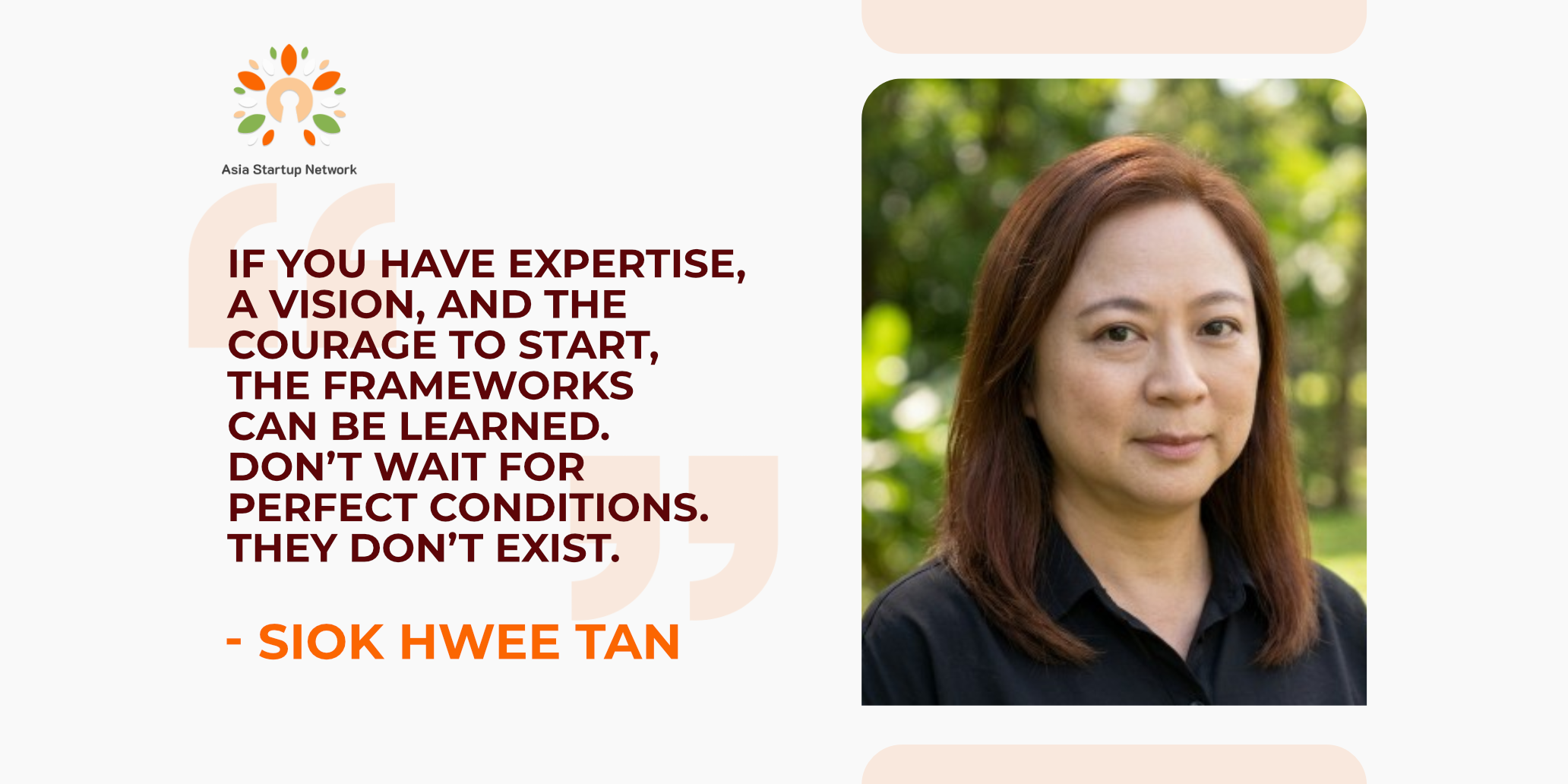
If you have expertise, a vision, and the courage to start, the frameworks can be learned. Don’t wait for perfect conditions. They don’t exist.
Q: What’s your long-term vision as an entrepreneur?
I want to prove that patient-centred innovation can be both impactful and commercially successful.
My goal is to build sustainable businesses that address systemic healthcare gaps — especially for underserved patient populations with limited treatment options.
Q: In one line, how would you describe your startup journey?
Turning personal tragedy into systematic change — helping one patient at a time.
Join Our Thriving Community
Stay updated with the latest insights and opportunities in the startup ecosystem across Asia.